

Good Cinema
The Truman Show
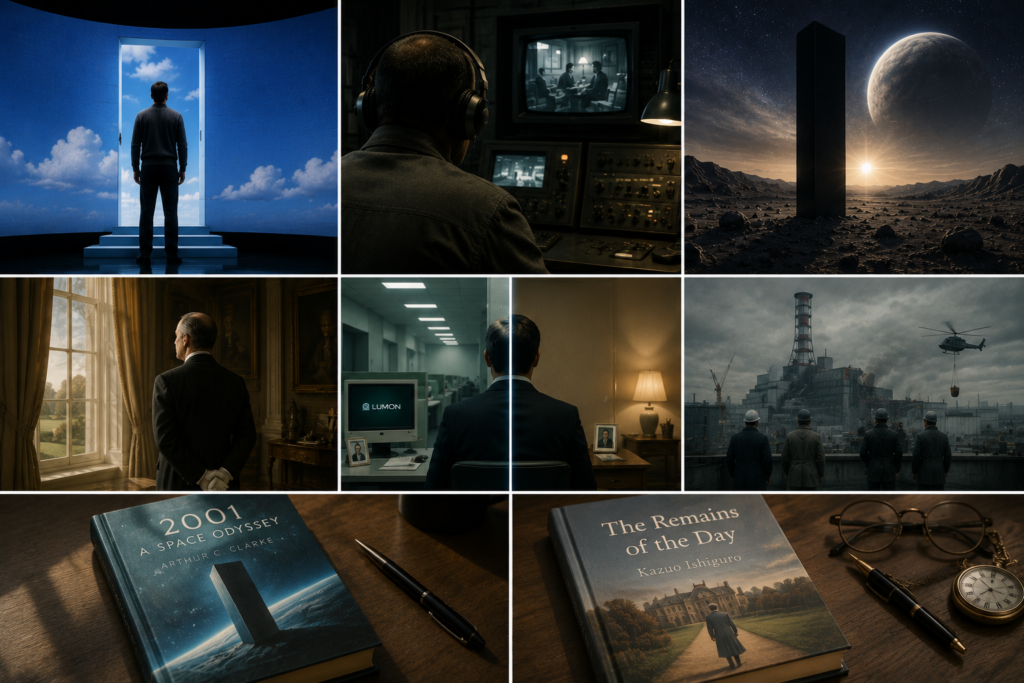
The Truman Show follows a man whose entire life has been transformed into a television program without his knowledge. Everyone around him plays a role, while an invisible system controls the limits of his reality.
Beyond its humor and apparent simplicity, the film raises disturbing questions about manipulation, conformity, freedom, and the human capacity to question the reality presented to us.
Why I recommend it: Truman begins to observe inconsistencies. He questions the system before he understands it.
The Lives of Others
In East Germany, a state security officer is assigned to monitor a writer and his partner. What begins as an institutional surveillance operation gradually becomes a profound human conflict.
The film explores power, obedience, ideology, intimacy, and the possibility that direct contact with another person’s life can transform our values and decisions.
Why I recommend it: Systems exercise power through human beings. But human beings do not always remain what the system expects them to be.
Good Books
2001: A Space Odyssey — Arthur C. Clarke
Human evolution, intelligence, technology, and the limits of our understanding converge in a journey that begins with prehistoric humanity and extends beyond the known boundaries of human existence.
The novel is not simply about space exploration. It asks what intelligence is, how it evolves, and what may happen when human beings encounter forms of intelligence that exceed their own.
Why I recommend it: Technological progress does not automatically mean that human beings understand the forces they create or encounter.
The Remains of the Day — Kazuo Ishiguro
An English butler looks back on a life defined by discipline, duty, and professional excellence. Gradually, his memories reveal the personal consequences of the values and assumptions that guided his decisions.
The novel is a subtle study of identity, loyalty, self-deception, and the enormous human cost of questioning one’s choices too late.
Why I recommend it: People do not make decisions only from facts. They interpret reality through values, roles, and the identities they construct for themselves.
Good Series
Severance
Employees of a corporation undergo a procedure that separates their professional memories from their personal lives. At work, they know nothing about who they are outside. Outside, they know nothing about what happens at work.
The series transforms the idea of work-life separation into a disturbing examination of organizational control, identity, power, and the meaning of work.
Why I recommend it: Few contemporary series ask a more radical organizational question: Who owns the person who exists at work?
Chernobyl
Chernobyl reconstructs the nuclear disaster and the institutional decisions surrounding it. The catastrophe is presented not only as a technical failure, but as the consequence of hierarchy, fear, distorted information, and a system in which telling the truth can be professionally dangerous.
Why I recommend it: Organizations can possess brilliant specialists and enormous technical resources and still fail catastrophically when power determines which facts may be communicated.